
Boom and Bust Cycles.
so goes the world

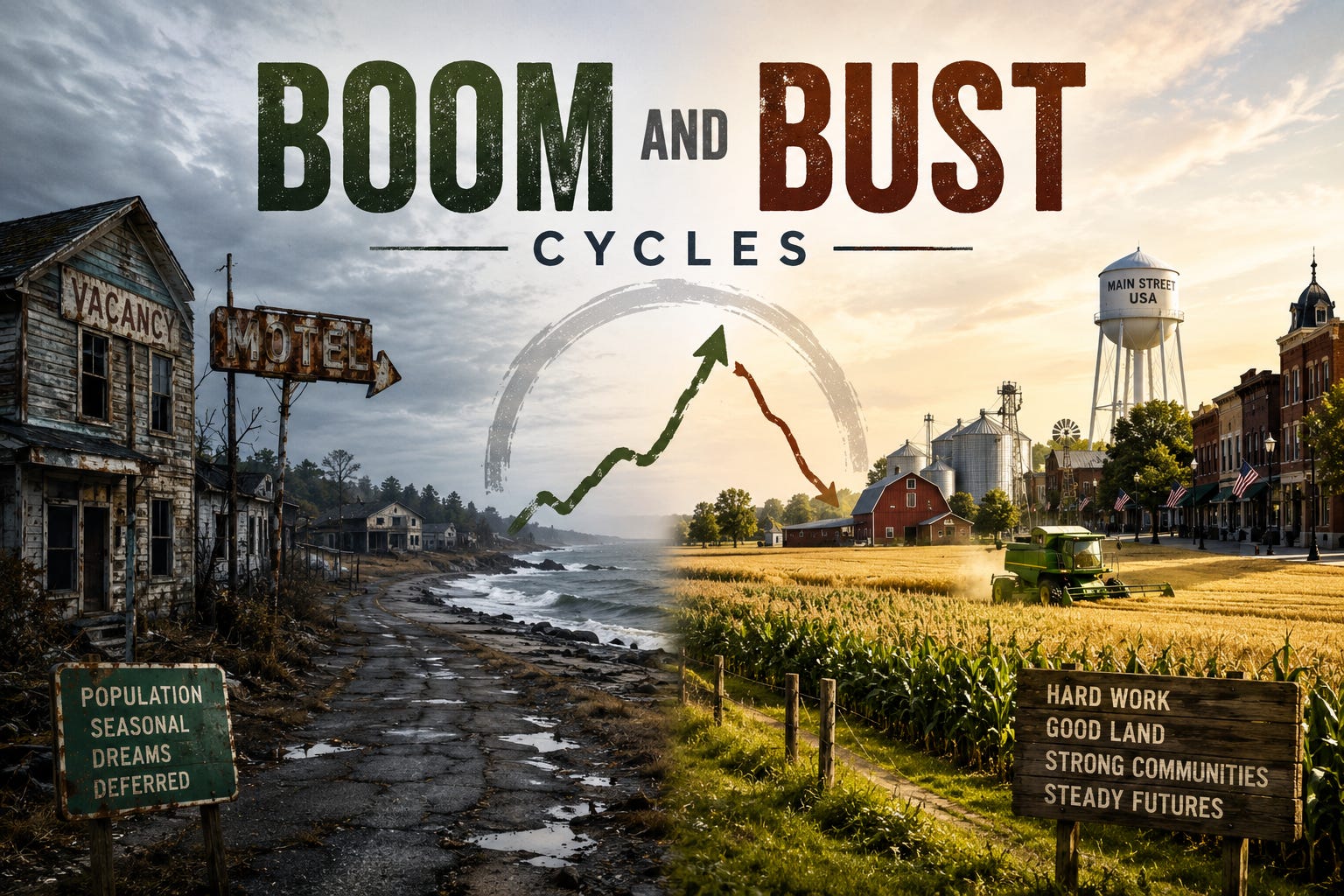
Recently, while driving my winding way up the North Shore of Lake Superior, I was struck by the change that seemed to be taking hold of that forlorn and windswept shoreline. Having driven through those forest-crowded and once mostly abandoned towns, if one could call them that, things have been changing … and it got me thinking about the macro-economics of boom and bust.
Having spent most of my life in the hard-bitten Midwest, where the economy and people thrive from the fat of the land and the sweat of the brow …
… and being an avid reader of history … it’s clear to me that we mostly have two major types of “areas” and their corresponding economies.
Tourism
Manufacturing/Agriculture
This might be an over-simplification, but after traveling over, around, and through these great States … at least in its current state, pun intended, I see these lines of economic demarcation clearly, like black and white.
If I’m traveling through the Midwest, let’s say for argument's sake, between the Ohio and Mississippi Rivers, maybe west out to the Platte River, you experience the Middle-Upper class belt that feeds America. It’s not ultra-wealthy, or ultra-poor, just classic Middle Class folk living a good quiet life with an exceptional quality of life.
Of course, we have our thin lines of tech hubs dotted on the coasts and here and there. Let’s throw them out the window for a moment; we all know we want to anyway.
I mean, I’m not an economist. Econ 101 in freshman year of college was boring as crap. But it’s much harder to have boom-bust cycles when you’re a primary contributor to agriculture, somehow, propped up by the Federal Government, like it or not.
![r/dataisbeautiful - [OC] United States of Agriculture: Top Agricultural Crop in Each State](https://substackcdn.com/image/fetch/$s_!S1Rr!,f_auto,q_auto:good,fl_progressive:steep/https%3A%2F%2Fsubstack-post-media.s3.amazonaws.com%2Fpublic%2Fimages%2F515cea79-7abe-497c-af16-da3b5ad547f2_640x360.png "r/dataisbeautiful - [OC] United States of Agriculture: Top Agricultural Crop in Each State")
Sure, the Ag world can have its cycles, like everything and everyone else, they are just more steady overall and less prone to the classic whiplash of tourist-driven areas. Just the slow pace of life with that constant injection of cash.
Just noticing stuff.
People don't stop eating during a recession, also they don't stop buying electricity. They don't stop needing fertilizer, steel, tractors, plumbing, or diesel fuel. They may delay replacing the pickup another year, but eventually it has to happen. Agriculture, manufacturing, logistics, healthcare, and construction all produce things society requires. Tourism produces something different.
It produces experiences. Experiences are wonderful, but they are discretionary. They exist only after the mortgage has been paid, the groceries have been bought, and people feel optimistic enough to spend what is left over.
That single distinction makes tourism economies fundamentally different from economies built around production. When confidence falls, vacations are among the first expenses families eliminate. Nobody cancels corn.
Research over the last few years has started to show something interesting. Tourism declines tend to hurt economies far more than tourism booms help them. In other words, the downside is asymmetric. A good season brings prosperity, but a bad season leaves empty storefronts, layoffs, declining property values, and local governments scrambling to fill budget holes. The elevator down is much faster than the escalator up.

Studies analyzing the tourism-growth nexus highlight this dramatic imbalance. Research from institutions like the UCF Rosen College of Hospitality Management found that a decline in tourism has a negative impact on economic output that is nearly seven times greater than the positive effect of an equivalent tourism boom.
Contrast that with the Midwest. Nobody drives across Iowa because it has the trendiest coffee shops or the newest boutique hotel. They drive through endless fields of corn and soybeans because those fields are quietly feeding a significant portion of the world. Manufacturing plants continue stamping out parts whether TikTok finds them interesting or not. Grain elevators are not dependent on influencer marketing. Railroads continue moving freight because the economy literally cannot function without them.
It is difficult to become fabulously wealthy in industries like these, but it is equally difficult for demand to disappear completely. There is an incredible resilience hidden inside businesses that make necessities instead of experiences.
The quiet powerhouse.
I think this also explains why Midwestern communities often feel strangely immune to the emotional extremes that characterize so many coastal economies. They rarely experience the euphoric highs of a technology boom or a tourism explosion, but they also rarely suffer the spectacular crashes that inevitably follow speculative periods. Growth tends to be slow.
Wealth tends to accumulate over generations instead of funding rounds. Homes remain affordable because they are places to live instead of investment vehicles. Main Streets survive because they primarily serve residents instead of visitors. It is not glamorous, but it is remarkably durable.
Maybe that is why I found myself thinking so much about those little towns along Lake Superior. They are beautiful places, and I genuinely hope they continue to prosper. In many ways they already are.
But I also wonder whether every new brewery, boutique hotel, souvenir shop, and vacation rental slowly shifts the center of gravity away from permanent residents and toward seasonal visitors. The economy becomes healthier right up until the moment something changes. A recession. A pandemic. Wildfires. Expensive fuel. Bad weather.
Changing travel habits. Suddenly an entire community discovers that it built itself around people who can simply choose not to show up next summer.
There is probably a lesson buried in there somewhere, and it extends far beyond tourism. We seem to live in an age where everyone wants to participate in the next boom. The next AI startup. The next crypto rally. The next housing surge. The next tourist destination. The next whatever.
Yet history keeps reminding us that civilizations, communities, and families are usually built on the boring things. Growing food. Building machines. Moving freight. Producing energy. Manufacturing goods. Solving real problems for people who still need those problems solved whether the stock market is up or down.
Maybe boring is underrated.
Just noticing stuff.
Interesting take, especially in a world of trillion dollar valuations and trillionaires.
I do agree that slow, steady, and boring wins the race..but I had never connected the dots to middle America. Cool thought!