
You Don’t Have a Spending Problem
You Have This Problem

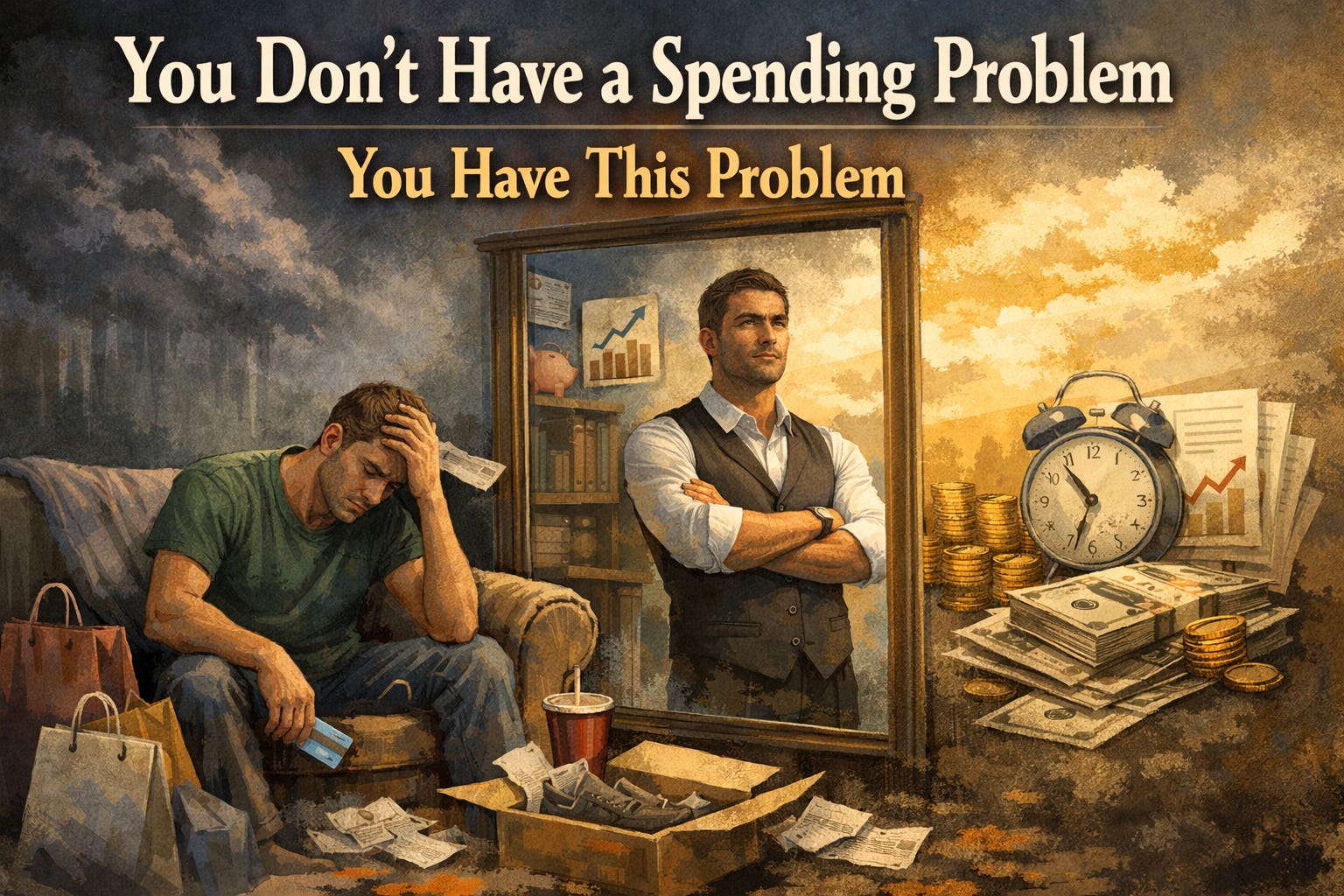
Most people think they have a spending problem, but what they actually have is something far more subtle and far more dangerous, because it hides behind good intentions, reasonable decisions, and the comforting illusion that if they just tightened things up a bit, downloaded a better budgeting app, or tried a little harder next month, everything would magically fall into place.
But it doesn’t, and it won’t.
Because the problem was never really spending. At least not in the way you think, it’s something more personal. It’s about you.
The Budget Lie
Budgets are one of those things that sound good in theory and feel productive in the moment, but quietly fail in practice because they try to solve a behavioral problem with a mathematical tool, like trying to fix a broken engine by repainting the car.
Look, I do a budget every month, so it seems a little tongue-in-cheek to say that. The thing is, I have proved my ability to live within my means, automate investing, and do all the rest, to the point that if I didn’t do a budget, nothing would change.
Research in behavioral economics has been pointing this out for years, even if the personal finance industry continues to push budgeting as the primary solution, because human beings are not rational calculators walking around making optimized financial decisions, but instead are deeply influenced by emotion, bias, and habit loops that override logic in the moment. (Wikipedia)
Even when budgets do have some effect, the real-world impact is inconsistent and often weaker than people expect, because behavior tends to revert unless something bigger changes underneath the surface. (Centre for Responsible Banking & Finance)
So people do what they always do.
They set a budget.
They break it.
They feel bad.
They try again next month.
And the cycle continues. Simply adopting a budget without looking inward, to the user of the budget, is never going to work. It’s sorta like telling yourself you will do the next diet, and go to the gym every day. Why doesn’t it work? Why can’t you just show up to the gym three times a week and look like a movie star?
Because sacrifice at that level, physical and financial, takes a more personal twist. It’s about an identity, fundamentally, what you believe in and who you are.
You need a big enough reason to actually change your habits.
The Real Problem: Identity
If you strip everything down, spending is not primarily about numbers; it is about identity, and more specifically, how you see yourself and how you behave when nobody is watching.
You don’t overspend because you lack a spreadsheet. You overspend because your habits, environment, and internal narratives align with a version of you who spends. That might sound abstract, but it shows up in very real ways.
You see yourself as someone who “deserves a treat” after a long day.
You see yourself as someone who “doesn’t want to miss out.”
You simply live in the moment… for every moment of your life.

You see yourself as someone who lives a certain lifestyle, even if it's on shaky ground. And once that identity is in place, your behavior follows it automatically, without much conscious effort.
The Psychology Nobody Talks About
There is an entire field dedicated to this called behavioral finance, and its core idea is simple but uncomfortable: people consistently make financial decisions that feel good in the moment but are objectively bad in the long term.

This is not a personal failure; it is human nature.
We are wired for short-term rewards, a phenomenon often called present bias, in which a smaller reward today feels more valuable than a larger reward later. (Wikipedia)

We are influenced by emotional triggers, social pressure, and marketing designed to bypass logic and tap into impulse. (Rocket Federal Credit Union)

We mentally categorize money in strange ways, treating a tax refund differently from a paycheck, even though it's the same dollar. (Booth School of Business)
And perhaps most importantly, we act in alignment with habits that have been reinforced over the years, not decisions we made five minutes ago.
One study found that financial well-being is strongly tied not just to knowledge, but to self-control and behavioral patterns, reinforcing the idea that knowing what to do is far less important than consistently doing it. (PMC)
Change your identity, change your finances.
Just like making any other serious change in life, job, fitness, financial, emotional, etc, it all boils down to us. You. Me. At the end of the day, we look in the mirror and find the reason that our bank account balance is what it is.
You think you just need to budget harder, save more, try harder, go out to eat less, or get a better-paying job?
Those things are well and good, but at the end of the day, you are still with you at the end of the day. You’re the one making the decisions in the moment, based on your worldview.
Personal finance is about personal responsibility.
This really resonates. One of your best posts IMO, thanks!